Where Generative AI Fits at Work
A study of 738 U.S. occupations exploring whether job characteristics can help predict where generative AI is most likely to be useful—and where current AI tools still fall short.
Problem
Companies cannot realistically test generative AI across every job, task, and workflow. I wanted to know: Could data about the work itself help companies identify better places to start? Rather than estimating what AI might theoretically be able to do, I focused on evidence from how people were already using it for work.
Approach
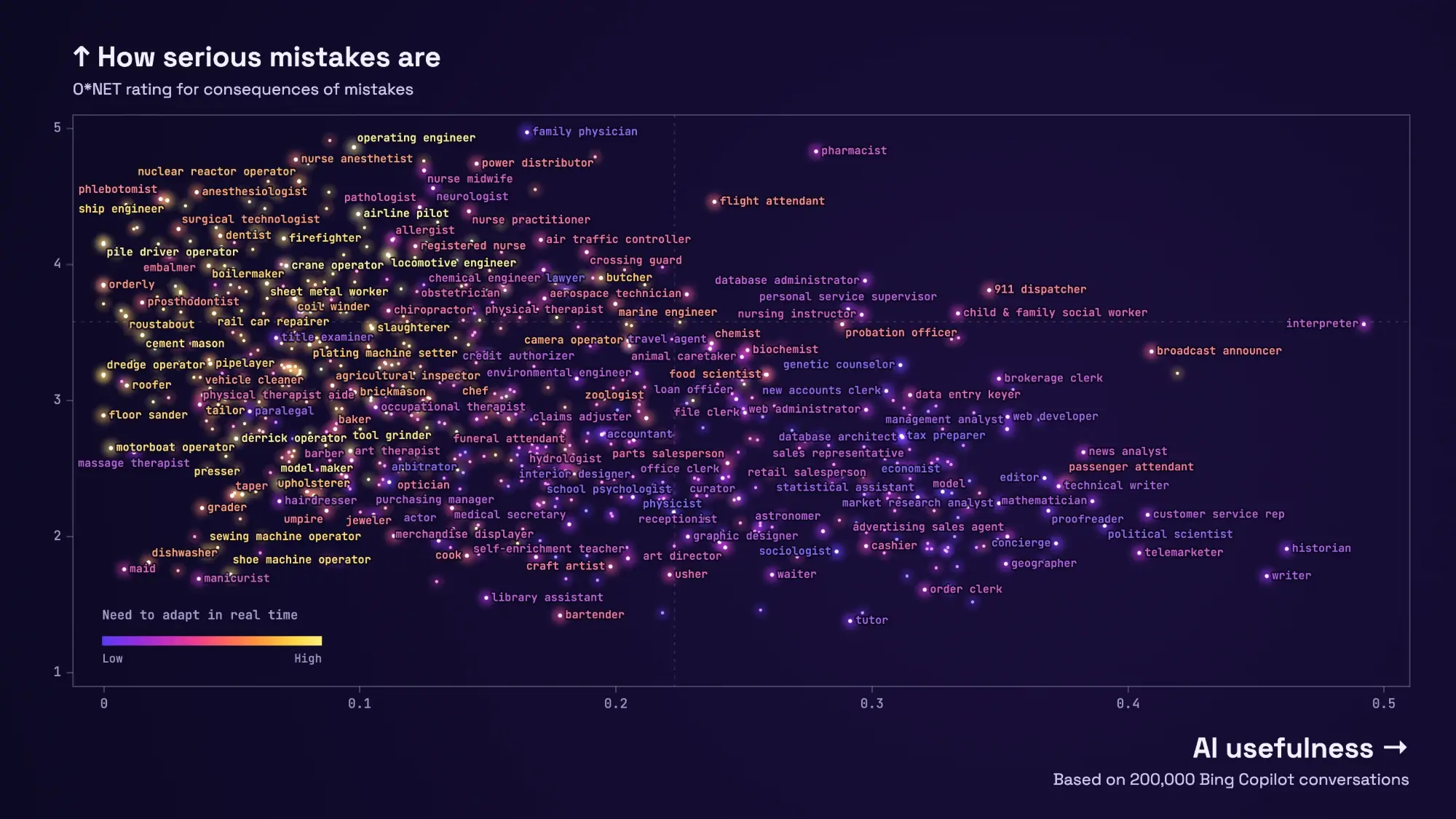
I combined data from 200,000 Bing Copilot conversations with O*NET, a U.S. Department of Labor database describing the skills, knowledge, working conditions, and other characteristics of hundreds of occupations. Using 738 occupations, I trained and compared models that predicted where generative AI was proving more useful based on characteristics of the jobs. I also investigated where Copilot appeared to complete users’ requests but received much less positive feedback than expected.
What I found
When given occupations they had not seen during training, the models could make strong estimates of where those jobs would fall from lower to higher AI usefulness (cross-validated R² = 0.72). Communication, computer use, creativity, and analytical thinking were among the strongest signals of greater AI usefulness; physical, manual, and mechanical demands pointed in the opposite direction.
I also found a distinct pattern in physical and mechanical work: Copilot was often judged to have completed the requested task, yet users gave the responses substantially less positive feedback. The difference was largest in jobs requiring people to continuously monitor changing conditions and adjust their actions.
Why it matters
Job characteristics could provide an early screening tool for AI pilots, helping organizations narrow many possible opportunities into a smaller set worth testing first. The findings also suggest that some work may require AI systems that can receive new information and update their guidance as conditions change.
Tools
Python · pandas · scikit-learn · AutoGluon · O*NET · Microsoft Working with AI